

I still remember the sound—a slow, ominous creak followed by the thud of my favorite heavy encyclopedia set sliding toward the center of the shelf. I was sitting in my favorite armchair, admiring the floor-to-ceiling library I’d just finished. Then I saw it. My prized collection of history books wasn’t sitting flat; it was huddling together in a dip that would make a valley blush. I’d spent weeks on those massive library built-ins, and within six months, gravity was winning. It’s a gut-punch for any homeowner. You want elegance, but you get a structural failure that stares you in the face every time you walk into the room.
Why Your Long Shelves Are Slowly Failing You
Building beautiful storage is one thing, but fighting physics is another battle entirely. Most people think that if they just buy thicker wood or use high-grade plywood, their shelves will stay straight forever. I fell into that trap myself. I once spent a small fortune on 1.5-inch thick solid oak, thinking thickness alone would stop the span from bowing. I was wrong. Wood is a natural material, and over time, it creeps. According to the Forest Products Laboratory, wood under a constant load undergoes permanent deformation. If you are planning a project with spans over 36 inches, you need more than just timber; you need the hidden strength of steel. Today, we are going to look at how to hidden steel bracket for massive bookshelf spans can save your design. Have you ever noticed your shelves starting to look more like a smile than a straight line?
Can wood really handle the weight alone?
The short answer is usually no, at least not for the long haul. Many of my neighbors ask if they can just add another bracket in the middle, but that ruins the clean look of creative built-ins. The fear of our shelves collapsing or even just looking ‘cheap’ because of a sag is enough to keep any book lover up at night. We want that high-end, seamless look without the bulky supports.
My $500 Mistake with Solid Oak
Early in my career, I ignored the advice of an old-school cabinet maker who told me to ‘iron out’ my spans. I thought he was joking. I built a massive unit for a client, used the best maple I could find, and within a year, the doors wouldn’t close because the shelves had bowed so much they were pushing against the face frames. I had to rip the whole thing out. It was a $500 lesson in humility. Since then, I’ve mastered the art of using hidden steel plate fixes to ensure that no matter how many heavy art books you stack, that shelf stays as level as the day it was installed. Whether you’re working on lateral support for tall library bookcases or a simple wall unit, these stiffeners are the secret sauce you’ve been missing.To stop the sag, you have to think like an engineer, not just a carpenter. Consider the wood your aesthetic skin and the hidden steel your skeleton. To get a 48-inch shelf to hold a set of heavy encyclopedias without a middle support, you have to rout the reinforcement directly into the core. This is the same principle I use when implementing 7 reinforcement tactics for wall hung bedroom vanities, where the weight of quartz can easily crush a standard frame.
Rout Your Way to a Straight Edge
The process starts with a plunge router and a straight-edge guide. You aren’t just cutting a shallow groove; you are creating a pocket for a 1/4-inch thick steel flat bar. I learned this lesson the hard way while building creative storage solutions for vanities; I once tried to simply screw the steel to the bottom of a shelf, but the screws eventually sheared under the tension. Now, I bury the steel inside a sandwich of two 3/4-inch plywood sheets. 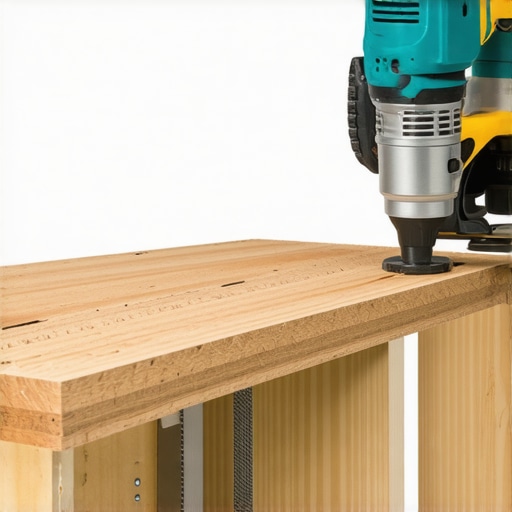
Depth Matters More Than Width
When you select your steel, remember that vertical depth is your best friend. A flat bar is easy to bend if it’s lying flat, but nearly impossible to flex if you turn it on its side. This is why the structural header move for wide alcove shelving is so effective. By embedding the steel vertically into a thick shelf or using stop floating shelf sag with internal torsion box engineering, you create a rigid beam that resists gravity indefinitely.
Connect the Steel to the Wall Structure
A reinforced shelf is useless if it’s just hanging off drywall. You have to transfer that load to the house’s framing. Just as I emphasize in a step by step guide to vanity installation for beginners, the connection to the studs is where the magic happens. I typically weld a T or L flange to the end of my steel shelf spines, allowing me to drive 3-inch lag bolts directly into the center of the wall studs.
Don’t Trust Drywall Alone
I once watched a beautiful set of pantry shelves slowly tear a hole in a client’s wall because they used standard anchors. Even high-quality 5 hidden anchor tactics for heavy pantry shelves on thin drywall have limits. For library spans over 3 feet, those anchors become a liability. If you’re dealing with masonry, you might need the scribing hack for perfect built in gaps against uneven brick to ensure your unit sits perfectly flush before you tighten those structural bolts. When everything is locked in, the shelf won’t just look straight—it will feel like part of the house.
A common misconception I see in DIY forums is the idea that if a shelf is sagging, you just need to ‘beef it up’ with thicker lumber. This is where most people get it wrong. In reality, increasing the thickness of a solid wood shelf without adding internal structural support often makes the problem worse. Why? Because you are adding significant ‘dead load’—the weight of the shelf itself—before you even place a single book on it. In my experience, a 2-inch thick solid oak slab will eventually bow under its own weight over a 4-foot span, regardless of how well it’s finished. This is the same principle I discuss when explaining why your heavy quartz vanity is cracking the cabinet frame; weight alone is an enemy, not a solution.
Is Plywood Actually Better Than Solid Hardwood for Long Spans?
Surprisingly, yes. High-quality Baltic Birch plywood is more dimensionally stable than solid timber. However, even the best plywood has a limit. The Architectural Woodwork Institute (AWI) sets strict standards for deflection, suggesting that a shelf should not bow more than 1/8 of an inch under its intended load. To hit those numbers on a wide library unit, you have to move beyond wood. I’ve found that the best results come from using stop floating shelf sag with internal torsion box engineering where a plywood skin is bonded to a rigid internal frame. This creates a lightweight but incredibly stiff structure that outperforms solid wood every time.
The ‘oops’ factor that catches even seasoned pros is neglecting the expansion and contraction of wood around the steel. If you glue a steel bar into a tight-fitting channel without allowing for seasonal movement, the wood will eventually split as it tries to shrink against the unyielding metal. I always leave a 1/16-inch gap at the ends of my steel channels and use a flexible construction adhesive rather than a rigid epoxy. This nuance is critical when you are trying to how to support quartz counters on custom floating vanities or other high-stress installations. If you don’t account for movement, the very reinforcement meant to save the project will be the thing that destroys it.
Another trap is focusing so much on the shelf that you forget the cabinet carcase. I once saw a beautiful library where the shelves stayed perfectly straight, but the sides of the cabinet were being pulled inward because the shelf reinforcements weren’t properly anchored to the wall studs. This is why I always recommend 6 heavy duty wall fixes for massive quartz top vanities to my clients; the entire system must act as one. You also need to look at the internal components, much like the the hidden internal bracing trick for extra deep kitchen sink bases, to ensure the vertical supports can handle the transferred load. Have you ever fallen into the ‘thicker wood’ trap only to see your project sag anyway? Let me know in the comments.
Once the dust settles and your books are finally on the shelves, the real test of a craftsman begins. Long-term success isn’t just about the day of the install; it’s about how that structure behaves five years from now when the seasons have changed and the wood has reached its equilibrium. To keep things from shifting, I rely on a few non-negotiable tools that go beyond the basic hammer and drill. For starters, I never step onto a job site without my digital inclinometer. While a bubble level is great for the basics, when you are dealing with hidden steel bracket for massive bookshelf spans, being off by even half a degree can create massive leverage issues at the end of a four-foot run. I use a Wixey WR300 Type 2 for my blade angles and shelf checks because precision at the start prevents a disaster at the end.
How do I maintain my heavy-duty storage over time?
Maintenance is often the forgotten step in custom cabinetry. Every six months, I recommend a ‘load audit.’ It sounds fancy, but it just means looking for signs of fatigue. Check the junctions where the shelf meets the carcase. If you see the finish cracking or a gap opening, your anchors might be shifting. This is especially vital for 6 heavy duty wall fixes for massive quartz top vanities, where the dead load of stone puts constant pressure on the wall studs. Grab a long straight-edge—I prefer a four-foot aluminum rule—and lay it across the span. If you see more than an 1/8-inch gap in the middle, it’s time to tighten those structural lag bolts or consider adding a discreet center support. For those struggling with movement, learning how to fix drawer fronts that wont stay aligned is often the first sign that the entire unit has slightly settled.
The precision gear that changes everything
If you really want to scale your projects, you need to invest in a joinery system that handles stress better than pocket screws. I personally swear by the Festool Domino DF 500. It allows me to create floating tenons that provide incredible shear strength, which is essential when you’re building creative storage solutions for vanities that need to withstand daily use. Unlike standard biscuits, these tenons are solid beech and resist the twisting forces that cause shelves to rack. According to the National Kitchen & Bath Association (NKBA), structural integrity in floating installations is the number one cause of long-term warranty claims, so over-engineering the joinery is actually a cost-saving measure in the long run. 
Where built-in design is headed in 2025
Looking forward, I predict we are going to see a massive shift toward modular reinforcement. Instead of permanent, static steel bars, we’ll see adjustable internal tensioning systems—think of them like truss rods in a guitar neck—that allow homeowners to ‘tune’ their shelves as they add or remove weight. This aligns with the top trends in vanity designs you need to know in 2025, where flexibility and longevity are becoming the new luxury. People are tired of ‘fast furniture’ and want built-ins that evolve with them. If you’re just starting, don’t be intimidated by the technicality. Follow a step by step guide to vanity installation for beginners to get the basics down, then move to these advanced structural tactics. My challenge to you: on your next project, skip the shelf pins and try a routed-in steel stiffener. You’ll never look at a standard shelf the same way again.
Bringing a massive project to life is about more than just the final coat of paint; it is about the structural integrity that remains invisible to the naked eye. After years of trial and error, I have realized that the most impressive libraries aren’t the ones with the most ornate molding, but the ones that stay perfectly level under the weight of a thousand stories.
What I Learned from Forty-Eight Inch Failures
First, never underestimate the cumulative weight of paper. A single linear foot of hardcover books can weigh thirty pounds; multiply that by a four-foot span, and you have a hundred-pound force acting on your joinery every single day. Second, I learned that the finish matters for more than just aesthetics. If you do not seal the back of your shelves as well as the front, they will absorb moisture unevenly and warp, regardless of the steel inside. I always tell my fellow builders to check out our built-in storage ideas to declutter and enhance your home for inspiration, but never let the beauty distract you from the load-bearing requirements. Finally, patience during the routing process for your steel inserts is non-negotiable. A rushed channel leads to a loose fit, and a loose fit leads to eventual shelf movement.
The Tool Chest Essentials for High-Stress Built-ins
I trust my digital inclinometer more than my own eyes when leveling wide spans. Precision is the difference between a high-end custom library and a DIY project that feels slightly off. For those just starting, I recommend diving into an expert guide to flawless vanity installation tricks tips because the core principles of finding studs and managing heavy loads are identical across all types of cabinetry. Also, keep a tube of high-performance construction adhesive specifically rated for metal-to-wood bonding; it is the only way to ensure your steel reinforcement doesn’t rattle or shift over time. #IMAGE_PLACEHOLDER_E#
Ready to Build Something That Lasts?
Building massive library built-ins is a legacy project. It is about creating a structural masterpiece that outlasts the house itself. Do not be afraid to over-engineer your supports; your future self will thank you when those shelves are still as straight as an arrow a decade from now. If you are looking for more ways to optimize your floor plan and storage, explore how to maximize your space with custom vanities expert design tips, which offers principles that apply to any room in the house. If you hit a technical wall and need a professional eye to review your plans, feel free to contact us anytime. Have you ever seen a shelf bow so badly it actually damaged the side cabinets? I want to hear your DIY horror stories or your structural successes in the comments below!